Why ZINC Keeps Your Moves Private
The Problem With Playing In Public
Imagine a strategy game where every move is face-up on the table. You can see my map. I can see yours. Anyone with faster tools can watch the board and react before the round closes. At that point, the strategic layer is gone.
Public chains are good at receipts. They are brutal for live strategy. That is the problem with building a proof-of-work mining protocol on a public blockchain like Solana without solving for privacy.
Every tile selection would be visible in real time. Sophisticated miners or bots could watch the chain, copy whoever looks informed, and adjust around them.
ZINC is different because it is built with @Arcium.
What Arcium Actually Does
Arcium is a confidential computing network on Solana.
That is the technical description. Here is the useful version.
Most computers need to read data before they can process it. You can encrypt data in storage. You can encrypt it in transit. But at the moment an ordinary system needs to do useful work, the raw data usually has to appear somewhere.
Arcium changes that.
It lets applications compute over private inputs without putting the full input in front of any single machine.
The technique behind this is called Multi-Party Computation, or MPC. Instead of one computer holding the whole input, the computation is split across independent nodes. Each node holds a secret share. No single node has enough to reconstruct the full picture.
The nodes work together. The computation runs. The result comes out. No individual Arcium node sees the underlying input.
Why This Matters For ZINC
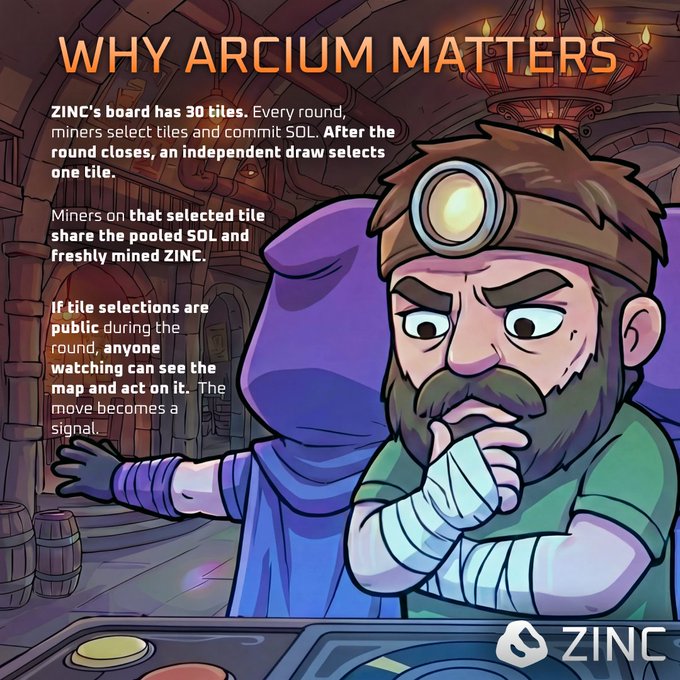
ZINC's board has 30 tiles. Every round, miners select tiles and commit SOL. After the round closes, an independent draw selects one tile. Miners on that selected tile share the pooled SOL and freshly mined ZINC.
If tile selections are public during the round, anyone watching can see the map and act on it.
The move becomes a signal.
With Arcium underneath ZINC, tile selections are encrypted. Other miners, public observers, and bots do not get a live strategy feed.
The privacy claim here is about the live round: your tile map stays hidden while it can still be used against you.
The draw is still checkable. ZINC publishes the result through its proof path, so anyone can verify the selected tile against the revealed draw without seeing the live tile map.
ZINC also uses private jitter in Brick rewards. Bricks are earned through mining, and the amount can reflect how focused your tile selection was. If that reward mapped too cleanly to your exact selection, it could leak strategy after the fact.
Private jitter adds a small hidden variation, so Brick rewards do not become a clean decoder for the map behind them.
Put together, the design removes the live public signal that bots would normally use to front-run, copy, or reverse engineer a mining strategy.
The Mine Is Open
ZINC is not privacy as a slogan.
It is privacy as a mechanic.
Arcium keeps the live strategy private. The proof path keeps the closed round checkable.
Public receipts. Private strategy.
Your moves stay yours.
Join the dig: zinc.cash
Related posts
Why The Stockpile Is Zinc's Second Mine
How ZINC's Stockpile turns mining activity into a longer-cycle pool built by rounds, Bricks, and Arcium randomness.
What Arcium is and why it changes the game in privacy
Arcium is a confidential computing network built on Solana, and ZINC uses it as privacy infrastructure for encrypted compute.

Bonanza: ZINC's big draw and why it matters
A breakdown of the Bonanza draw, how its pot builds, and why showing up every round matters.