What Arcium is and why it changes the game in privacy
EN only
Arcium is a confidential computing network built on Solana. It lets programs run computations over encrypted data without any single party, including the nodes doing the work, ever seeing the raw inputs. The result comes back verified and the data stays private the whole way through. That is the short version, and it is worth sitting with, because most blockchains do the opposite. They broadcast everything to everyone by default.
The team behind Arcium came out of Elusiv, a zero-knowledge privacy protocol on Solana that raised a $3.5 million seed in November 2022 and was sunset in March 2024. While building it, they kept hitting the same wall. ZK proofs are great for hiding one person's data, but they fall apart when several parties need to compute over shared secrets that none of them should fully see. Arcium is their answer to that problem. The company now describes itself as an encrypted supercomputer and has raised over $15 million, including a $5.5 million strategic round led by Greenfield Capital that brought total funding to $9 million at the time. That round drew Coinbase, Heartcore Capital, Longhash VC, L2 Iterative Ventures, Staking Facilities, Smape Capital, and Everstake, plus angels including Solana's Anatoly Yakovenko, Monad's Keone Hon, Helius co-founder Mert Mumtaz, and Jito co-founder Lucas Bruder.
How does it actually work?
The core technology is multi-party computation, or MPC. The idea is old in cryptography and simple to state. Several nodes each hold a fragment of the encrypted data, they compute together, and the correct answer falls out without any node reconstructing the full input. No trusted hardware, no decryption step in the middle.
Arcium runs this inside Multi-Party eXecution Environments, which it calls MXEs. A developer spins up an MXE, picks the cluster of nodes, the security model, and the protocol, then submits work to it. Solana handles orchestration and scheduling. The actual encrypted compute happens off-chain across the node clusters, coordinated by what Arcium calls arxOS. On Mainnet Alpha those clusters are run by independent operators including Staking Facilities, Triton One, H2O Nodes, and Greenfield Capital.
There are two MPC backends. Cerberus runs under a dishonest majority assumption, which means the computation stays private and correct as long as one single node is honest, even if every other node turns malicious. Honest nodes detect the misbehavior via MAC failures and generate the proof that identifies the cheater, which then triggers slashing. Manticore is the faster backend, built for heavy workloads like AI, and it trades some of those guarantees for speed under an honest-but-curious model.
This is also where Arcium separates itself from the alternatives. ZK proofs require the prover to know the data in plaintext, so they cannot handle shared private state. Pure FHE can compute on encrypted data but stays slow and lacks strong built-in verification. Trusted execution environments lean on hardware makers and attestation services you have to trust. Arcium's pitch is encrypted compute that is fast, verifiable, and does not put a single hardware vendor at the center.
Why privacy has been so hard to ship
Until recently, adding real privacy to an application meant hiring cryptographers and implementing MPC, FHE, or ZK circuits close to the metal. That is expensive, slow, and easy to get dangerously wrong.
Most teams simply skipped it.
Arcium's bet is to turn privacy into infrastructure you call rather than something you build.
Developers write confidential instructions in Rust using a framework called Arcis, then use the arcium CLI, which wraps Solana's Anchor tooling, to build and deploy. A confidential instruction ends up looking a lot like any other Solana instruction. Your on-chain Anchor program stores encrypted state and calls Arcium to run the private logic, and Arcium returns the result. Arcium counts more than 500 apps deployed during its public testnet, which says the tooling holds up. The network went live as Mainnet Alpha on February 2, 2026. One of the first applications on it is Umbra, a shielded transfer and swap layer that drew roughly $155 million in ICO commitments through MetaDAO before launch.
The idea underneath all of this is encrypted shared state. A normal smart contract keeps its variables public. An Arcium application can hold variables that stay encrypted while still being computed on by a group. That unlocks sealed-bid auctions, confidential order books, private voting, and games where hidden information is the whole point.
What is ARX actually?
ARX is Arcium's network token. As of mid-June 2026 the token generation event has not happened yet, but it is getting close. Arcium says the TGE is coming soon, and ARX was just added to Coinbase's listing roadmap. The token is not listed or trading anywhere yet.
One thing to watch out for: copycat tokens using the ARX ticker already exist on other chains. The real one is an SPL token on Solana and is not tradable yet.
What is confirmed comes from Arcium directly. ARX is an SPL token with a baseline supply of 1,000,000,000 and a dynamic mechanism that can inflate to pay node operators when demand is low and burn when demand is high.
The CoinList community round, which ran March 24 to April 1, 2025, priced the token at $0.20, allocated 20,000,000 ARX, targeted $4 million at a $200 million fully diluted valuation, and unlocked 100% at TGE with no vesting.
On utility, Arcium is specific. ARX captures usage-based network fees from transactions that touch Arcium or its C-SPL confidential token standard.
Holders delegate ARX to MPC nodes to secure the network, and rewards track each node's performance, with underperformers losing delegation over time. Computation scheduling is stake-weighted, so more delegated ARX means a node is picked to schedule work more often. Governance is on-chain, with voting power that scales with lockup duration. That design makes sense for a compute network. Staked ARX is the collateral that keeps node operators honest. Fees from network usage accrue to the same token, and governance runs through it. What Arcium has not published is a full breakdown of team, investor, and community allocations or a hard TGE date, so treat anything claiming those as unconfirmed.
Where ZINC fits in
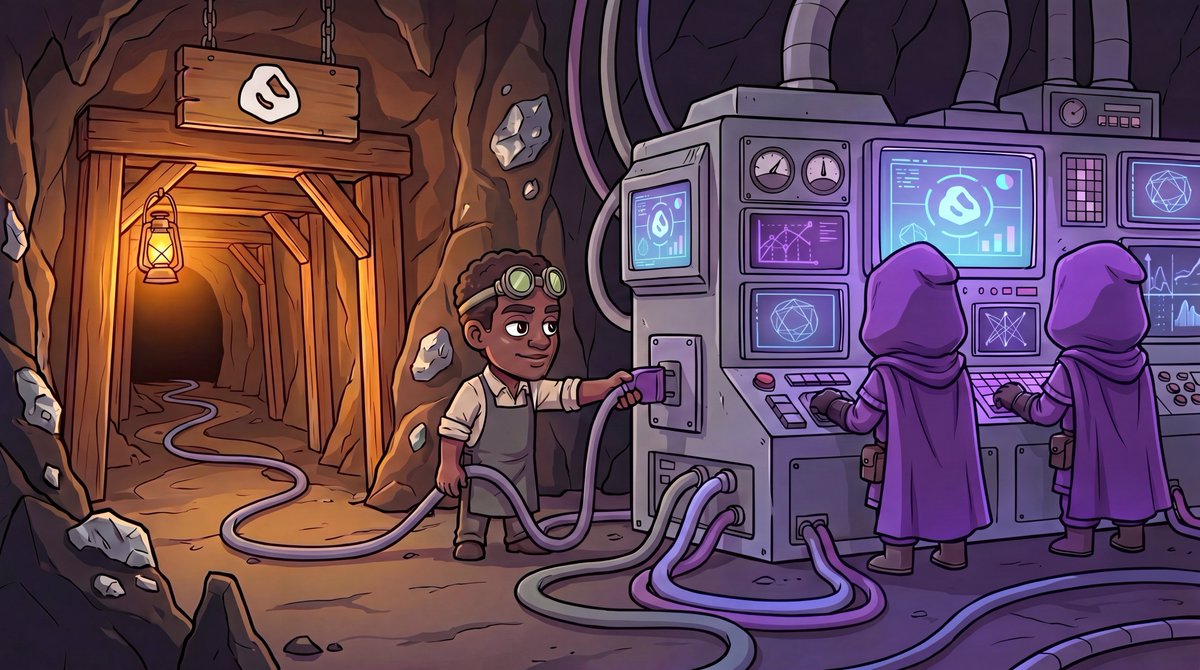
ZINC is our privacy-preserving proof-of-work mining token on Solana, fair launched with a fixed supply of 6,538,000, a nod to the atomic weight of zinc. Miners deploy SOL across a 30-tile circular board every 30 seconds, and whoever sits on the winning tile shares the pooled SOL while mining fresh ZINC. Tile selections are encrypted through Arcium and never exposed, not even after the round ends. Private strategy.
Privacy in ZINC is structural, not a feature bolted on later. Building MPC infrastructure in-house was never realistic for a team like ours, and frankly it should not be. By running on Arcium, we inherit a confidential compute layer, Solana-native tooling, and the guarantees of Cerberus instead of reinventing cryptography from scratch. That is the whole argument for treating privacy as infrastructure. You call it, you do not build it. We wrote more about that decision in Why we are building ZINC on Arcium.
Arcium is still early. The token has not launched, the network is in Mainnet Alpha, and plenty remains unproven at scale. But the direction is clear and the developer experience is real today. For builders who want confidentiality without a cryptography department, and for a protocol like ours where secrecy is the mechanic, that is a meaningful shift.
Follow @Arcium for the network side.
Join the dig: zinc.cash
The ZINC team.
Related posts
Why The Stockpile Is Zinc's Second Mine
How ZINC's Stockpile turns mining activity into a longer-cycle pool built by rounds, Bricks, and Arcium randomness.

Why ZINC Keeps Your Moves Private
How Arcium keeps live ZINC mining strategy private while preserving public verification after each round.

Bonanza: ZINC's big draw and why it matters
A breakdown of the Bonanza draw, how its pot builds, and why showing up every round matters.